
When I knew I’d be going to the Dominican Republic for a few months during my year of travelling around the Caribbean, it was my hope from the beginning that I’d end up making a friend from Haiti or somehow ending up being able to go to Haiti, seeing as it’s right next to the Dominican Republic.
Obviously Haiti doesn’t have the best reputation in the media, and many people seem to think it’s one of the ‘worst’ countries in the world. Honestly, when I hear controversial/bad things about a place, it often gives me an even stronger desire to go there and discover the truth behind the negativity. That was definitely the case for Haiti.
In the Dominican Republic, I was volunteering in a community of Haitian people who had moved there, so my interest in getting to know Haitian culture etc grew even stronger as I spent more time in their community and heard some Haitian music, saw some Haitian food etc. I was also quite intrigued by the Haitian Creole that was spoken in the community. I studied French and Spanish at University, and languages are quite fascinating to me so I was always listening and trying to match up some of their words with similar French words (because Haitian Creole is related to French).
Luckily, I met a friendly family of missionaries (American husband and Haitian wife with two children) who were on holiday in the Dominican Republic, and we kept in contact and they invited me to visit Haiti and stay in their missionary centre for a week, and of course I accepted the offer.
There are various ways to cross between the DR and Haiti, but I’ll tell you about the way I did it (with my backpack covered in plastic bags because of torrential rain)…
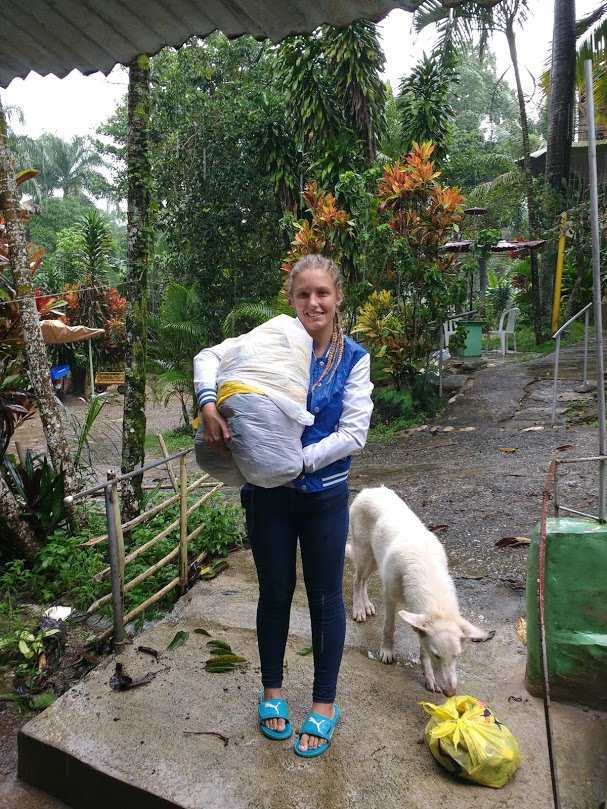
I crossed at Dajabon, one of the two border towns. To get to Dajabon, I used public transport from the village I was staying in which is called Munoz. Here’s how it works:
First I took a ‘ruta’ (route taxi… basically a car that works like a bus with a set fare and set route) from Munoz to Puerto Plata, the nearest city. This costs 35 pesos (approx. 75 cents US) and takes half an hour.
I got off the ruta at La Javilla which is a small square in Puerto Plata which some ‘guaguas’ (minibuses) go from. The guaguas that go from La Javilla are (unsurprisingly) called ‘Javilla Tours’, but it’s easy because once you walk by La Javilla, people will be asking you where you want to go and they’ll put you on the right guagua.
Anyway, you need to get in a guagua to Navarrete. This costs around 100 pesos (approx. $2.50 US) and takes about an hour.
In Navarette, there’s a very obvious place (kind of an ‘island’ between two main roads) where you wait for the next bus. Basically just stand exactly where you get off the guagua and wait for more buses to come. You’ll definitely know when a bus is going to Dajabon because it’ll pull up by the ‘island’ and shout “Dajabon”. They could also ask you if you’re going to “la frontera” (“the border”). The buses come quite frequently – around every 15 minutes apparently.
I actually was lucky enough to know someone driving from Navarette to Dajabon, so I got a ride, but I saw the buses that were going there while I was waiting for my ride, and when I came back from Haiti I took the same bus from Dajabon to Navarrete.
The journey is pretty long, about 3 hours, and if you’re on a regular bus/guagua, there are frequent stops along the way at security bases. I can’t speak for the Navarrete to Dajabon journey, but on the Dajabon to Navarette journey, the police got on the bus at every single security stop (approximately every 20 minutes) and asked everyone for ID. They were mainly focusing on the Haitians (checking that they were allowed to be in the DR I think), but also checking that they weren’t bringing anything illegal with them. In general, they weren’t particularly polite or friendly, especially to the Haitians.
In Dajabon, the bus station is either a walk or a ‘moto’ ride (motorbike taxi) from the border.
Now for the hectic part…
Once you’re near the border, everything becomes a bit intense. Sadly there are a lot of Haitian children begging for money very persistently, and a lot of adults trying to make money in whatever way they can, such as offering to carry your suitcase for you, or taking you across the border on a ‘moto’.
There was just a lot going on from all angles, so it was a little overwhelming and I wasn’t really sure who to respond to or where to look! Any place that’s super busy and hectic is probably a place where you should keep an extra eye on your phone/bags etc in my opinion, so I did this, and just tried to be aware of what was going on around me (although it was difficult because so much was going on!)
When I’m heading to somewhere hectic with lots of my stuff with me, I usually put my phone and passport in my bra or somewhere safe like that, and put any bigger valuables low down in my backpack – not near the zips or anything. If you don’t want any moto (which I didn’t) or anyone to carry your stuff, I found it worked to just politely but firmly say “no, gracias” (no, thank you), and if you don’t want to give any money to the children, just say “no, lo siento” (no, sorry) or “no tengo cambio” (I don’t have change).
There aren’t any clear signs or anything indicating this, but the important thing that you need to do is make sure you go into the customs (‘aduana’ in Spanish) at EACH END OF THE BORDER. If you don’t do this, you’ll basically be entering the other country illegally.
You will have to pay a fee at each customs office, and to be honest, there are different stories from different people about exactly how much the fee is, and it seems like the officers don’t exactly stick to one rule. In total, to cross from the Dominican Republic to Haiti and back again, I paid around $40 US, but divided up between the different customs offices, so basically $20US in each office.
After the customs office, there’s a big, robust looking gate. I wish I could have taken more pictures, but I was trying to keep my phone away mostly. The gate only has a small opening and there are a lot of people trying to get through as quickly as possible, so there’s quite a lot of pushing and shouting and confusion.
To get through the gate, Haitians and Dominicans just have to show an ID card to the officer by the gap, but as a foreigner, you need to make sure you still have your passport at hand, and any stamp or paper you received in the office. You might have to join in with the pushing if you actually want to get through.
This is Massacre River that you’ll walk over near the gate. As you can see, people wash their clothes in it:

My experience with the border office on the Haitian side was that the staff basically sit outside chilling out, so if you go in and there’s no one at the desks, just walk around and go outside the office until someone notices you.
When you’re done in the customs office on the Haitian side, there are plenty of motos and buses to take you where you need to go.
If you think the border crossing on a regular day isn’t hectic enough for you, you could try doing what I did on my way back from Haiti which is cross on the notorious market day. Most people avoid that, unless they want to go to the market, but I always like a challenge and I wanted to hear what all the fuss was about, so I left Haiti on a Monday to go back over. (Market days are Mondays and Fridays).
On these days, the border area basically becomes a free trade zone, so it’s very popular with buyers and vendors from both countries. This time, there were even more motorbikes zooming around in all directions, even more shouting, and loads of goods being transported on people’s heads, in baskets and on bikes etc. This was definitely the most plantains I’d ever seen on a bike before:

Obviously I stood out like an alien at this market, so a lot of people were shouting things at me, often just asking where I’m from etc. They were probably just a bit surprised. I didn’t feel threatened at any point, and I stopped to buy some oranges from a friendly looking Haitian lady and I ended up chatting with her friends for a few minutes.
I changed my spare Haitian Gourdes back to Dominican Pesos at the border too. There were about 10 men all sitting on chairs outside the customs office with massive wads of cash in their hand, shouting “Pesos” at me. The exchange rate they gave me wasn’t the best, but it wasn’t completely ridiculous either so I just went with it.
Crossing on market day was really interesting and I loved it. Obviously I would suggest the same precautions that I already mentioned for the regular crossing about keeping your valuables in a safe place etc.
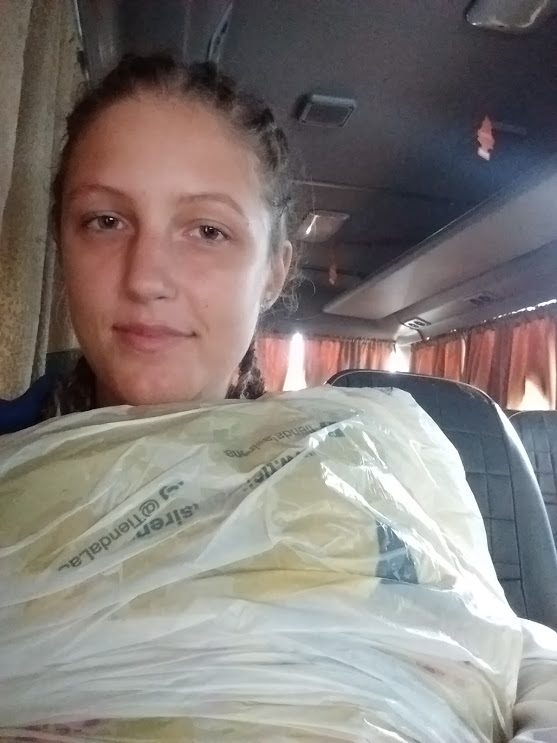
Once I was back in Dajabon, I bought some roast corn on my walk to the bus station. Unfortunately I don’t have a photo, but there was a whole row of about 20 Haitian women on the floor roasting corn using charcoal. Anyway, this is me with my oranges and corn feeling happy about having conquered the border by myself:

I’d read a lot of horrible things online about the border, such as armed robberies being done by people dressed up as police etc., and I’m not able to guarantee that these things don’t happen, because I only crossed once each way, so I wouldn’t want to advise anyone on whether or not it’s a good idea to do it alone, but I hope hearing about my experience will be helpful anyway. If you do cross on market day, definitely bring some change for some fruit and roast corn!


 TRAVELWITHZOE
Leave a reply to raymon calleja Cancel reply